
Ashish Narsale lists the features of the phones that are the rage this festive season.

If you're shopping for a new laptop, you might want to consider one of these. NS Sawaikar tells you why.

There are few firms that are applauded for managing a healthy top line growth along with an impressive brand image that inspires most companies.

Chinese mobile brands are deeply entrenched in the Indian market. A move to bar them may send a bold diplomatic message. But its cost for the local industry is anybody's guess. In the event that Chinese brands face curbs, two handset makers - Samsung and Apple - squarely stand to gain.

Xiaomi said in a statement that "it isn't easy" to build up a patent portfolio as a start-up company, but it aims to have filed 8,000 applications by 2016.

Here is what we expect will be the top innovations of 2015

Bidders eyeing parts of Canadian smartphone maker than the whole company, say sources

We tell you why you should consider buying one of these top 5 smartphones this Diwali!

Nokia agreed in September to sell its devices and services business and license its patents to Microsoft for 5.44 billion euros after failing to recover from a late start in smartphones.

The company hopes to revive its fortune with the move
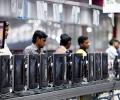
It was expected that supplies from China will be back to normal by end-June as their factories are now operating at nearly 90 per cent of normal capacity. But the recent issue with shipments has placed an obstacle that manufacturers can't bypass.

This is the first time that sales of smartphones exceeded that of feature phones.

Alnoor Peermohamed reports on Apple's two-faced strategy to grow its base in India without compromising on premiumness.

New Google CEO Sundar Pichai made ascent with low-key style and technical chops.
As competition for the smartphones market hots up, new players are making waves.
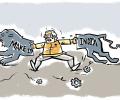
Work is underway in identifying global companies in sectors ranging from electronics, auto components and medical equipment to shift part of their existing or incremental manufacturing to India.

India is the world's third-largest smartphone market.

Tim Cook, CEO of Apple, recently stated that he sees India in the same position that China was seven to ten years ago
India's e-commerce sector is expected to touch $22bn in 2015.

From screen size to device options to memory, the next iteration of iPhone, will leave the world dazzled if these speculations come true.

Loss-making Nokia gains full control of the profitable venture Nokia Siemens Networks for $2.2 billion, a cheaper than-expected price, analysts said, although they also noted the acquisition would put pressure on Nokia's balance sheet.

As much as Rs 8,000 crore worth of mobile phones in this segment - out of a total of Rs 15,000 crore - come into the country through the grey market. The government imposed the duty on these phones primarily to encourage domestic production but the strategy has failed as the bulk of high end mobile phones are currently imported.

Not only is this hidden from the user, it's often unrelated to the app's purpose.

Google is going ahead with a policy revision mandating 30% charge on in-app purchases across all apps on Play Store. This has left developers' community worried about tighter squeeze on their earnings, says Yuvraj Malik.

'The pressure on relative performance and the feeling of being left out among many investors may also account for the belief among many that this has to be a technology stock bubble.' 'The feeling of a bubble is also reinforced by the extreme performance gap between growth and value investing.' 'While at first glance, one can only stand back awestruck by the wealth creation delivered by technology stocks globally. It does not seem at all like the internet bubble of 1999-2000, says Akash Prakash.
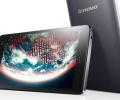
According to CyberMedia Research, over 7.46 lakh tablets were sold in the January-March 2014 quarter by as many as 30 domestic and international vendors.

Industry body to write to commerce ministry, seek regulation for e-tailers.

Competition in the booming multi-billion dollar Indian smartphone market is further set to intensify with e-commerce giants Amazon, Flipkart and Snapdeal all set to launch Google's much-awaited sub-$100 (around Rs 6,000) handsets on Monday.

The foremost lesson is that technology has got commoditised.

Nearly six out of 10 post-millennial respondents own a smart phone, but what is remarkable is that the difference in ownership patterns between metros (58.50 per cent) and mini metros (59.36 per cent) is not much with the smaller cities scoring over the larger ones, TCS said in a statement.

Customers can link their cards to banks' app and make payments after scanning a 'quick response' code.
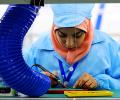
The government's stated vision is that it wants to make India a manufacturing hub and that is where such a rush or confusing policies don't help, reports Shubhomoy Sikdar.

'India missed the software products revolution (and now is in danger of missing the platform revolution), complacent that we are the software experts of the world based on IT services prowess,' points out Rajeev Srinivasan.

Recently, Prime Minister Narendra Modi met over 40 CEOs across broad swathes of industry, ranging from makers of mobile devices, auto components, food products to telecom networking equipment and pharmaceuticals. The agenda: To discuss how to make India an integral part of the global supply chain. The focus of the discussion would be the much touted yet not so well understood production-linked incentive scheme (PLI), the centrepiece of the government's drive to massively boost the manufacturing sector. To do so, the government has created a war chest of over Rs 197,000 crore to be paid out as incentives to over 14 industries in five years. There are three objectives to the scheme, two explicitly stated, one implied.

Following the footsteps of Motorola, Chinese handset maker Xiaomi is also teaming up with e-Commerce major Flipkart to launch its handsets in India.

In the last few years, zero per cent financing has become quite attractive as consumers aspire to buy the latest products, especially in categories such as mobile phones and television sets.

Both the Xperia Z3 and Z3 Compact come with 2.5 GHz quad-core CPU featuring 3 GB RAM.

The Chinese smartphone maker's focus on offline retail has helped it overtake Samsung in top 50 cities in India.

Android M would be built directly into cars allowing drivers to enjoy all the benefits of the internet without even plugging in their smartphones.

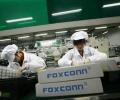
Chinese smartphone maker Xiaomi Inc has tied up with Taiwan's Foxconn to start assembling phones in India.
 © 2026 Rediff.com - Advertise with us - Disclaimer - Privacy Policy - Sitemap - Feedback - About us - Terms of use - Grievances